
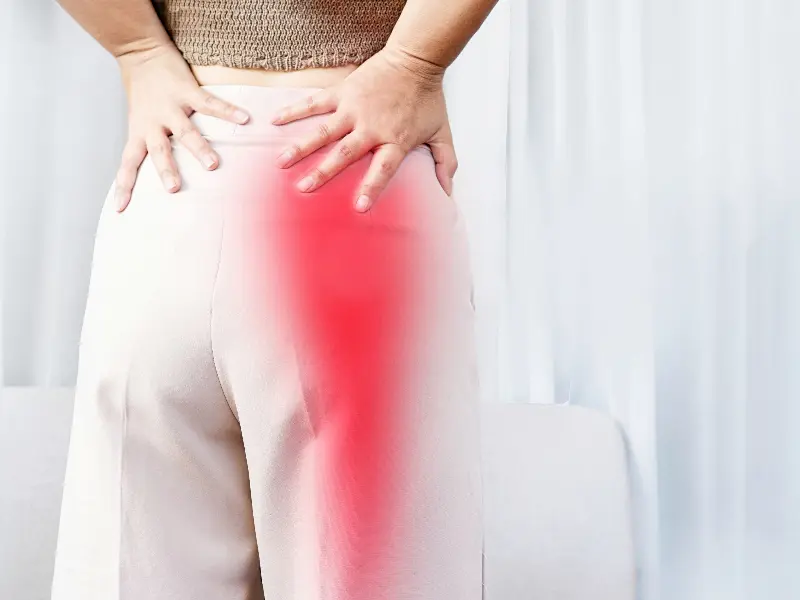
The sciatic nerve is a large nerve that originates from the lumbosacral area of the spine and supplies sensory input to the back and side of your leg, as well as the bottom and side of your foot. It also controls the coordination of the muscles of the posterior thigh, anterior and lateral leg, and feet. When we talk about “sciatica” or “sciatic nerve” pain, what we are referring to is experiencing pain along the path of the sciatic nerve. Very commonly, we will hear pain in any portion of the leg referred to as “sciatica,” when in reality it refers to a very specific distribution of the pain.
Sciatica can present as a very annoying and debilitating pain. It is often characterized by sharp, burning, numbing, and tingling pain in the posterior leg and can travel down into the foot. Risk factors for sciatica include conditions and situations that can irritate or compress the sciatic nerve. These situations can include degeneration of the lumbar spine, a sedentary lifestyle, and carrying excess weight.
Sciatica is a very common issue for many reasons. The lower part of our spines receives and manages a large load of weight and stress for the body. This increased stress, coupled with improper joint movement, is a recipe for spinal wear and tear. Additionally, our modern lifestyles do not support good lower back hygiene. Commonly, we sit for long periods without moving, which weakens our core muscles. All of these can be factors that lead to injury and degeneration of the lower back spine, which can cause sciatica.
Those experiencing sciatic pain should promptly seek chiropractic care. The sign that you are experiencing physical symptoms is your body setting off a “red flag” that an issue needs to be addressed. Sometimes sciatic nerve symptoms can come and go, reappearing when aggravated. It is important to keep in mind, however, that if there has been pain in the sciatic nerve distribution before, it is a sign of damage.
Evaluating by a chiropractor is especially important when you are experiencing sciatica pain, because chiropractors offer a unique, corrective approach. Chiropractors are specialists with the spine and nervous system, highly trained to find and treat issues such as sciatica. Conventional approaches to addressing sciatica may include medications to reduce pain and muscle stiffness, as well as specific stretching and strengthening exercises. Sometimes these suggestions can be helpful, and sometimes they are ineffective or serve only as a band-aid for the problem. At Rowe Chiropractic Offices, your chiropractor will perform a detailed analysis to identify the root cause of the sciatic pain and determine the best treatment plan to resolve it.
$99 New Patient Special
We sit knee-to-knee for a detailed consultation on your primary concern to get an overall understanding of your health. We’ll assess your neurology, posture, and biomechanics during our thorough spinal discovery examination. X-rays may be taken to further identify the cause of your health issue.
How Our Care Plan Works
1. Freedom of Knowledge
Even in the worst of circumstances, it helps patients to know exactly what is going on. Through one-on-one doctor patient reports and group education lectures we empower our patients with the knowledge and understanding of their specific problem.
2. Freedom of Choice
The fact that you didn’t know you are supposed to care for your spine from birth is not your fault, but it is your responsibility. OUR responsibility is to guide you in the pathway to health. It’s your choice to decide how you want to participate in your health care.
3. Freedom of Health
Your health is your responsibility. Our job is to share our findings with you and lead and encourage you in the pathway to health. It’s your choice to decide how you want to participate in your health care and how you want to show up in life.
How We Treat Sciatica In Midtown East, NY
Comprehensive Consultation and Exam
The first step to fixing your sciatica is to have a comprehensive consultation and exam to determine the source of your symptoms. When you arrive at Rowe Chiropractic Offices, the doctors will sit down with you for a detailed consultation to better understand your current symptoms and medical history. Based on the discussion during the consultation, the examining chiropractors will perform a series of tests to assess your condition. This examination will include tests such as evaluating your posture, checking your range of motion, orthopedic testing, and looking for signs of misalignments in the spine affecting the nervous system (called subluxations). Additionally, the chiropractor may suggest x-rays, which we can take in-house.
Taking the time to conduct all these analyses is crucial to identifying the problem’s root cause. Finding the root cause means that our patients can start their journey to fixing their spinal issues for good. It is our goal to determine the best treatment plan to effectively and accurately address the underlying cause of your sciatica symptoms.
Specific Chiropractic Care in Midtown East, NY
To understand how chiropractic care can be so effective in managing sciatica symptoms, it is important to understand subluxations. Subluxations are misalignments of a person’s spinal vertebrae or posture that affect nervous system functioning. The reason this is so significant is that your nervous system is the master control center for the whole body. Any interference with the nervous system functioning has a direct impact on your health and well-being.
Many issues can arise from subluxations in the lumbar and sacral areas of the spine. The nerves in the lumbopelvic area supply many of the critical pelvic organs, including the large intestine, kidneys, bladder, and reproductive organs. The nerves in the lumbopelvic area also supply the sensation and musculature of the lower back, legs, and feet. While subluxations in the lumbar spine can also affect other body systems, common signs of subluxations of the lumbopelvic nerves include pain/numbness/tingling in those areas, as well as issues with digestion, urination, and reproductive health.
Chiropractic care is superior to conventional treatment models because it directly addresses the cause of sciatica pain. Chiropractors are the only health professionals trained to find and correct subluxations, which are corrected through spinal adjustments. Spinal adjustments involve the chiropractor using their hands to move the vertebrae in a specific direction to correct their misalignment. By repositioning the spinal vertebrae back into place, the stress on the nervous system is reduced, and the symptoms you’re experiencing resolve.
Custom Therapeutic Exercise
Part of your journey to relief from sciatic pain includes rehabilitating your posture to reduce the stress on your nervous system. When we have a healthy postural alignment, our spinal cord rests relaxed in the spinal canal behind the spinal vertebrae. This allows our nervous system to function normally, and because the nerves control all of the body’s functions, our body can therefore function optimally. When we start to distort our posture and develop postural subluxation patterns, our nervous system becomes stressed and can no longer function properly.
Every person’s postural subluxation pattern is unique to their life experience and the many micro- and macro-traumas they have endured. At Rowe Chiropractic Offices, we create a customized plan to correct your postural subluxation pattern. This plan involves creating your therapeutic exercise routine and repeated coaching to help you master it.
When our posture is distorted, it can affect nerve function through postural subluxations and can also cause stress on the muscles and ligaments that have to hold our posture in an abnormal state. Tightness of the lower back and pelvic muscles, especially the piriformis, can compress the sciatic nerve directly and cause sciatica symptoms of pain, numbness, and tingling that travel down the leg.
By restoring your body’s ideal, balanced posture, you reduce the stress to your nervous system and help the supporting muscles relax into their healthy resting state. The type of exercise and stretching routine that would provide the best relief depends on the underlying problem, which the chiropractor needs to assess. Once the chiropractic assessment is complete, specific, symptom-relieving exercises can be taught to help move you towards a permanent solution.
Common Causes of Sciatica in Midtown East, NY
Spinal Stenosis
Spinal stenosis refers to a narrowing of the spinal canal that compresses nerves and reduces blood flow. Your spinal column is like a suit of armor for your delicate spinal cord. There is a space behind each of your spinal vertebrae, and when all the vertebrae are joined, this forms the spinal canal. It is through this spinal canal that the spinal cord and spinal nerves travel. The spinal canal provides a protected “highway” for your nervous system. When the spinal canal narrows, it can physically compress the spinal nerves and cord.
Symptoms of spinal stenosis include symptoms of a nerve that is being compressed and inflamed. This can include symptoms such as pain, numbness, cramping, and weakness that can worsen over time if the issue is not corrected. Sometimes progressive stenosis can even lead to issues with walking and control of bowel and bladder function.
Things that improve spinal stenosis include measures that create more space in the spinal canal. When your chiropractor determines that spinal stenosis is the cause of your symptoms, they can then determine how best to allow for more space in the spinal canal. Often, the treatment course will include adjustments to reposition the misaligned spinal joints, causing degeneration and a loss of space, postural rehabilitation exercises, and traction therapies.
Degenerative Disc Disease
If biomechanics at the spinal vertebral joint are poor, the joint’s integrity and strength can gradually weaken, leading to degeneration. Degenerative disc disease is sometimes viewed as a condition of “getting old,” but in reality, it is a sign of a problem that has persisted in the spine for too long. Frequently, we have people present to our office with degenerative disc disease in a part of the spine, while other parts of the spine have healthy discs. Those discs belong to the same person, so if the condition is age-related, shouldn’t all of the discs be affected the same? The degeneration in a part of the spine is more closely related to a long-standing biomechanical subluxation.
In Degenerative Disc Disease (DDD), the spinal vertebral joints begin to break down over time. An obvious sign of DDD is the breaking down of the fibrocartilaginous fibers, causing a loss of fluid in the disc and loss of disc space. When there has been long-standing DDD, bony osteophytes (aka “bone spurs”) eventually form, jutting out from the vertebral joint margins due to chronic inflammation and injury.
The real risk factors for DDD are the things that would cause spinal and postural subluxations. It’s these spinal and postural subluxations that cause the joint dysfunction and breakdown. Some factors involved in this include mechanical, chemical, and emotional stresses to the body. Mechanical is typically the easiest to understand, but can come from varied sources. Mechanical stress on the body can come from sitting for long periods, performing repetitive movements throughout the day, not moving your body enough, carrying extra weight, putting stress on the spine through lifting and bending, and high-performance athletics like running. Chemical stress can take many forms, as well as through the ways we are exposed in our environment – the chemicals we consume, breathe, and absorb. And lastly, emotional stress can disrupt communication between the brain and the body, leading to distortions in the spine and posture.
DDD affects the body in many impactful ways. Certainly, if the DDD is present in the parts of the spine that affect the sciatic nerve, you can get sciatica symptoms. Wherever the DDD is present, it will result in symptoms of those related nerves and body areas. This means DDD can not only cause pain and discomfort, but it can also affect the functioning of the nerves. This can lead to subtle changes in the body’s functioning over time.
At Rowe Chiropractic Offices, we care for DDD and the resulting sciatica through a multifaceted approach. We use our expertise to determine where the DDD is occurring and how it is affecting your body and symptoms. From there, we use a series of chiropractic adjustments, postural corrective exercises, and traction therapies to address the underlying cause of the degeneration.
Herniated or Bulged Lumbar Discs
One common cause of sciatica symptoms is lumbar disc herniation. In normal, healthy anatomy, the spinal discs have two main central components: an inner nucleus, comprised of a gel-like fluid that functions like a ball bearing on which the spinal vertebrae can move, and a surrounding annulus fibrosus, a matrix of tough collagen rings that provides strength and stability while also permitting movement.
In a disc with healthy biomechanics, the annulus fibrosus does a great job of holding the nucleus in place. However, if the biomechanics of the spinal vertebral joint are impaired by subluxation, this can result in damage to the annular fibers. This damage can happen gradually over time with micro-traumas or rapidly in acute, intense traumas. When the fibers of the annulus fibrosus begin to suffer damage, the nuclear material begins to be squeezed and migrate out of its central position into the annular fibers. What is seen is a bulge of the disc in the area where the nucleus is migrating.
If a disc bulge is left unaddressed, that injury will progress to the point where the nuclear material has reached the edge of the spinal disc. In severe cases, the nuclear material can also move into the spinal canal space. This migration of nuclear disc material to the disc periphery is called a disc herniation.
The symptoms of a disc bulge and a disc herniation can be very similar, though the severity of symptoms may differ. Disc bulges can often be seen in cases of chronic pain, with the worst, sharp pain being present in cases of disc herniation. Sometimes differences in pain can be felt: bulges more commonly cause annoying, dull pain and stiffness, while herniations cause sharp, intense burning and numbness.
The best treatment for disc bulges and herniations is to correct the biomechanical stress that causes the damage. This biomechanical stress is caused by subluxations of the spinal vertebrae and by a person’s posture. Chiropractic treatment is highly beneficial because chiropractic adjustments restore proper alignment of the spinal vertebrae and reduce nerve stress, which can cause sciatica symptoms.
Muscle Strain or Spasm
Muscle strains can also contribute to sciatica symptoms. When muscle strains occur, the muscle fibers are damaged due to acute or chronic injury or stress. When this occurs, inflammation forms to help heal the injury and relieve associated pain.
The sciatic nerve is a large nerve that runs either directly beneath the piriformis muscle or, in some people, through it. Because of this close relationship between the piriformis muscle and the sciatic nerve, any irritation to the piriformis muscle can irritate the sciatic nerve. When the piriformis muscle spasms or tightens, this can lead to physical compression of the sciatic nerve.
Muscle strains can result from sudden injuries or chronic stress. Acute, sudden injuries are often easy to understand and commonly involve muscle twisting, but not always. It is important to note, however, that while the onset of a muscle strain causing sciatica symptoms may seem sudden, the issue can sometimes build over time before the final injury occurs. Chronic stress on a muscle can arise from issues such as posture and body alignment imbalances, as well as from our modern lifestyle, which can cause us to position our bodies in ways that are counterproductive to our health, such as sitting for long periods.
Muscle strains heal by reducing inflammation and providing rest and time for the injury to heal. Muscle movement and activation can prolong recovery time. Icing, compression, and elevation of the strained muscle can also aid the healing process, but some of those methods may not be feasible in areas like the piriformis muscle.
It is important to have your injury evaluated by a chiropractor, especially if it is causing you sciatic-type pain. Muscle strains can be a sign of other issues, and sometimes what feels like a muscle strain may actually be something else. A muscle strain injury could indicate that a severe postural pattern is developing, distorting your healthy postural alignment and stressing your nervous system. Sometimes, pain associated with a muscle strain could originate from another area of the body or from nerve irritation.
Sacroiliac Joint Dysfunction (SI Joint Pain)
Another potential causative factor in sciatica pain to consider is sacroiliac (SI) joint dysfunction. The sacroiliac joints describe the articulations on either side of the sacrum (tailbone) with the iliac (pelvic) bones. This joint is very strong and is supported by numerous robust ligaments.
The sacroiliac joint serves an important role in our body. It helps distribute the weight between the upper torso and legs. This joint deals with both the upward forces of the legs and the downward forces of our upper bodies’ weight. It allows for movement while maintaining the stability of our spine and pelvis.
Sacroiliac joint dysfunction can be a source of sciatica-like pain. Although technically sciatic pain must arise from the sciatic nerve, pain in the sacroiliac joint can be deceptively similar. Sacroiliac joint pain can feel similar to sciatica, and both can cause pain in the gluteal muscles and legs. Sacroiliac joint pain may also be felt more localized to the SI joint and can sometimes refer pain to the acetabulum or groin. If SI joint pain travels down the leg, it typically does not go past a person’s knee, whereas sciatica pain can travel further into the calf and foot.
The best treatment for SI joint pain is to identify the cause of SI joint dysfunction and inflammation—subluxations of the SI joint are very commonly the culprit. Once your chiropractor determines the location and direction of your SI subluxation, they will provide a specific chiropractic adjustment to remove the irritation and restore normal functionality.
Frequently Asked Questions
Should I see a doctor or a chiropractor about Sciatica?
A chiropractor is specifically trained not only to evaluate sciatica symptoms and determine the cause, but also to perform an adjustment of the spine or pelvis that is causing the symptoms. If you’re looking for corrective care, chiropractic is the way to go.
What can I do to relieve my sciatica pain in Midtown East, NY?
“Quick-fixes” exist to help reduce some sciatic symptoms, like certain stretches or pain medication. Still, if you want a permanent solution, you need a chiropractor to identify and correct the cause of your sciatica.
What is the best treatment for sciatica?
The best treatment for sciatica is to reduce the inflammation and irritation of the sciatic nerve. There are many causes of sciatica pain, and once your chiropractor identifies the subluxation causing it, they can correct it with a specific chiropractic adjustment.
How long does sciatica last?
Sciatica can be acute or chronic. It is important to know that pain is your body’s way of informing you that something is wrong, and it’s your responsibility to listen. Once the irritation causing the pain is removed, symptoms start to reduce and resolve. Unaddressed sciatic pain can last for days, weeks, months, and cycle between symptomatic and asymptomatic for years.
Can stretching make sciatica worse?
Depending on what is causing the sciatica, stretches could sometimes increase the pain and sometimes relieve it. That’s why it’s important to have a professional chiropractor evaluate your sciatic symptoms.
What causes sciatica flare-ups?
Sciatic flare-ups are the body’s way of telling us that there is enough inflammation to put it in crisis, and it sends the distress signal of pain. Acute sciatic symptoms can sometimes be caused by a sudden traumatic injury, such as in sports accidents. Still, even more commonly, it is a build-up of many, many micro-injuries over time from lifestyle habits like poor posture, lack of movement, improper movement, and improper bending/lifting.
$99 New Patient Special
We sit knee-to-knee for a detailed consultation on your primary concern to get an overall understanding of your health. We’ll assess your neurology, posture, and biomechanics during our thorough spinal discovery examination. X-rays may be taken to further identify the cause of your health issue.